
Solutions
Protecting the River Teifi means tackling every source of pollution, not focusing on one alone. Wastewater treatment works, storm overflows, agricultural runoff, septic tanks, urban drainage, industrial discharges and emerging pollutants all contribute to the pressures facing the catchment. Lasting improvements will only be achieved by addressing these challenges together, using evidence to identify the greatest risks and the most effective solutions. Our advocacy is therefore balanced, constructive and evidence-led. We champion practical solutions, encourage investment where it will have the greatest environmental benefit, celebrate good practice, and hold all organisations—and ourselves—to account. Healthy rivers are not created by blame; they are restored through shared responsibility, collaboration and action.
Focus
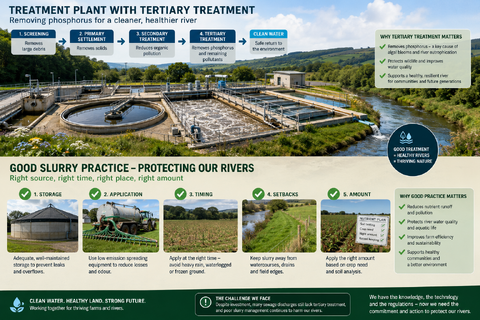
Evidence shows that wastewater treatment and agricultural nutrient management are two of the most significant opportunities to improve the River Teifi. Accelerating phosphorus removal at sewage treatment works, alongside better slurry storage and application practices on farms, could deliver substantial reductions in nutrient pollution while longer-term catchment restoration measures are developed. Our advocacy therefore supports practical, evidence-led solutions across all sources of pollution, ensuring investment is targeted where it delivers the greatest environmental benefit.
Every well-managed slurry store, every properly designed silage clamp, every fenced stream, every buffer strip and every carefully timed nutrient application helps keep pollution out of the Teifi. Supporting farmers to adopt best practice is one of the most effective ways to reduce diffuse pollution.
But agriculture is only part of the picture. Wastewater infrastructure must also improve. Reducing storm overflow (CSO) discharges through investment in sewer networks and treatment works, together with wider adoption of tertiary treatment to remove nutrients such as phosphorus and nitrogen before treated effluent is returned to the river, is essential if we are to tackle eutrophication and restore water quality.
Across the Teifi catchment, DCWW itself confirms 33 WwTWs, 66 pumping stations and 204 km of sewer serving nearly 14,000 households and businesses in the Teifi catchment (excluding private systems like abattoirs and cheese-manufacturing) discharge "treated" effluent into the river system. While some treatment plants have enhanced phosphorus removal, many still rely on conventional treatment, and further investment is needed to reduce nutrient pollution. AMP8 (2025–2030) provides a once-in-a-generation opportunity to accelerate upgrades, install enhanced phosphorus removal where needed, improve storm overflow performance and deliver the greatest environmental benefit to the Teifi.
But investment alone will not restore the river. Better land management, reduced agricultural runoff, habitat restoration and nature-based solutions must all work alongside modern wastewater treatment. We have the knowledge, the technology and the regulations. Now we need the urgency, collaboration and accountability to ensure every organisation plays its part in protecting a healthy, thriving River Teifi for future generations.